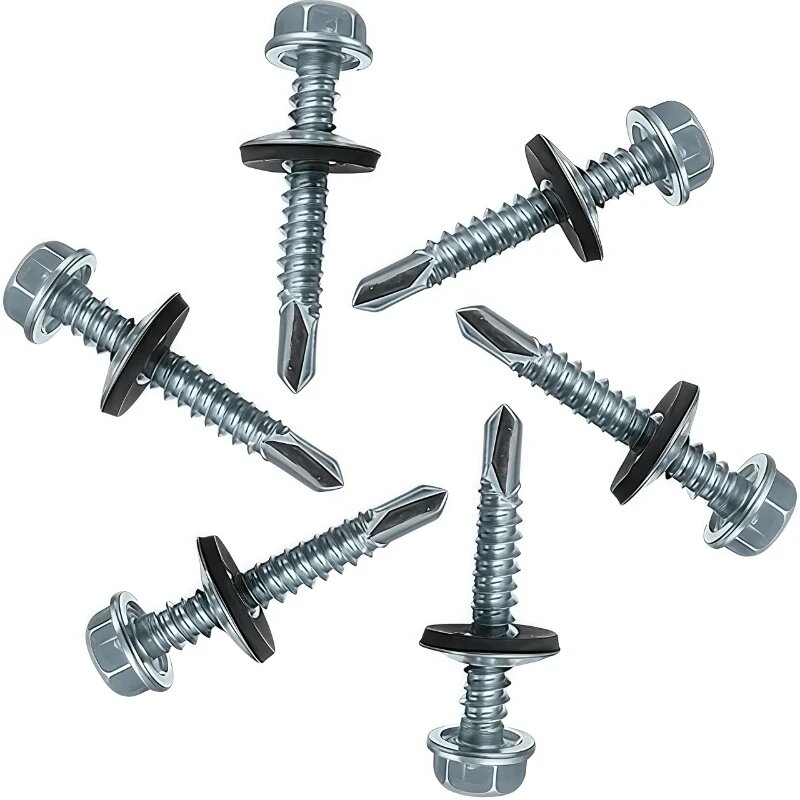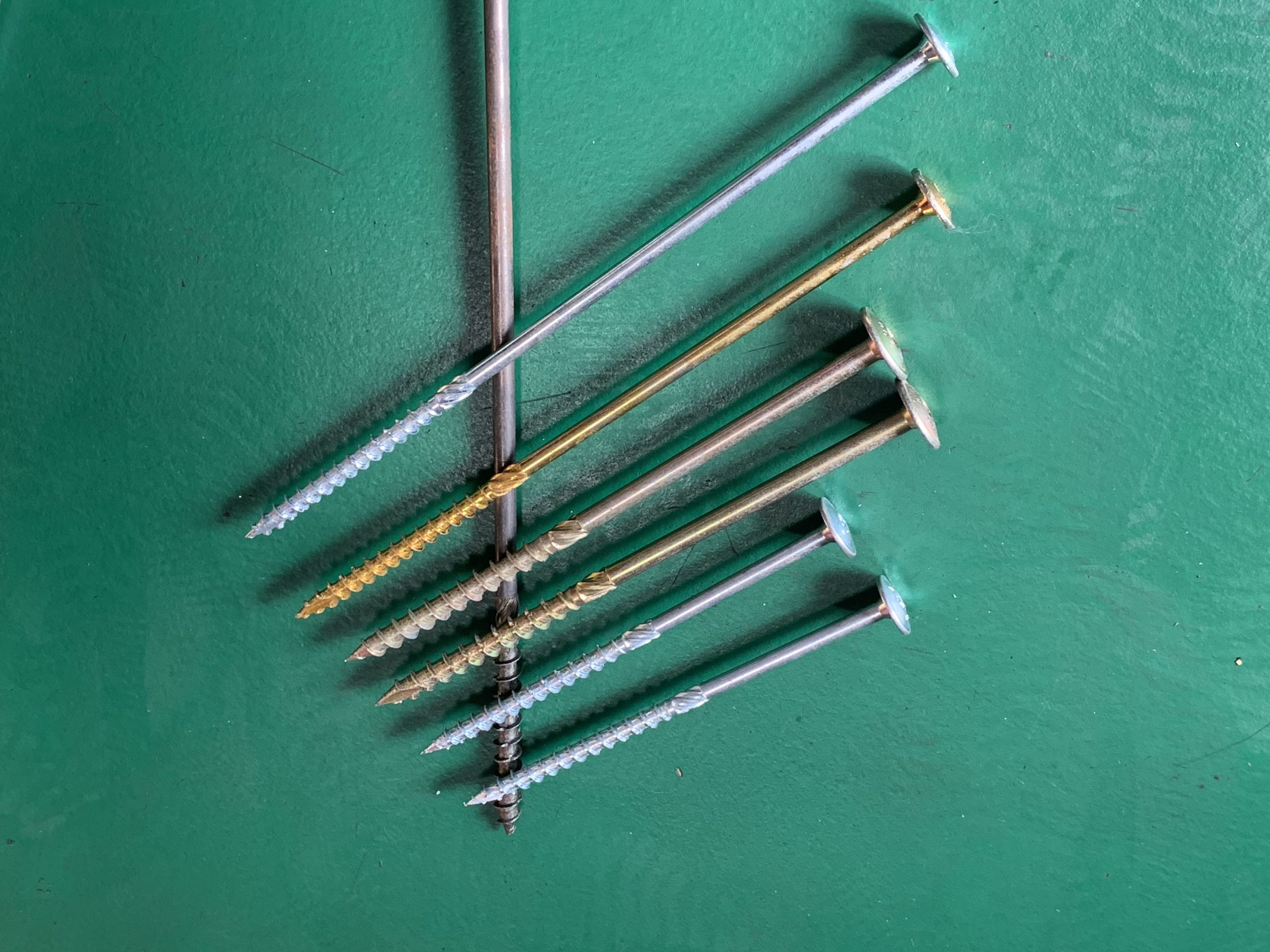
Color-zinc plated high-strength chipboard screws are a type of self-tapping screws, mainly used in woodworking, decoration, and other scenarios.
Core Features
1. Material and Craftsmanship
Made of high-strength carbon steel and treated with hardening, they have high hardness and are not easy to break. The surface is coated with color zinc, which provides rust and corrosion resistance and extends the service life.
2. Design Details
Adopting a countersunk (flat) head + torx slot (or Phillips slot) design, they fit flush with the material surface after installation for a more aesthetic appearance. The optimized threads (single-threaded with deep pitch) enable fast drilling and reduce the risk of wood splitting.
3. Application Scenarios
Suitable for fixing chipboard, wood boards, ecological boards, and other materials. They are often used in furniture assembly, wall decoration, woodworking projects, etc., and can also be used with power tools to improve construction efficiency.
4. Diverse Specifications
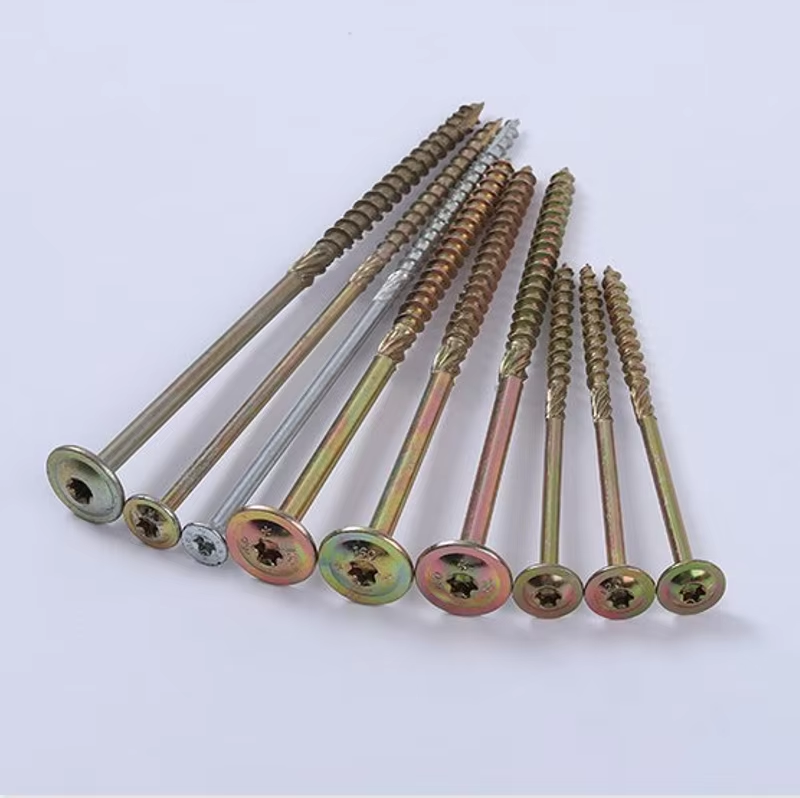
As shown in the figure, they are available in various lengths and thicknesses (e.g., M3.5, M4, M5, etc.) to meet the needs of materials with different thicknesses.
I. Precautions for Selection
I. Precautions for Selection
1. Precise Specification Matching
- Length: Select based on the material thickness. For example, for a 15mm-thick wood board, choose 25-30mm-long screws to ensure the driving depth is ≥ 2/3 of the material thickness.
- Diameter: Common sizes range from M3.5 to M5. Choose thinner screws (M3.5) for thin materials and thicker screws (M4-M5) for thick or hard materials.
2. Focus on Core Craftsmanship
- Material: Choose “hardened carbon steel” (preferably with “HRC45+” marked on the packaging). Avoid low-quality soft steel, which is prone to breaking and thread slipping.
- Rust Resistance: The color-zinc coating should be uniform (no spots or peeling on the surface). For humid environments, prioritize models with “environmentally friendly color zinc + passivation treatment”.
3. Slot Type Selection Based on Needs
- Torx Slot (style shown in the figure): More anti-slip and wear-resistant than Phillips slots, suitable for high-speed operation with power tools.
- Phillips Slot: Compatible with ordinary screwdrivers but prone to thread slipping with long-term use. Torx slots are recommended as a priority.
II. Precautions for Use
1. Tool Matching
Use torx bits of corresponding specifications (e.g., T20/T25). Set power screwdrivers or drills to “low torque + low speed” to avoid breaking screws due to excessive torque.
2. Material Compatibility & Pre-Drilling Pilot Holes
- Only use on wood materials (chipboard, solid wood boards, ecological boards); do not use on hard materials such as metal and ceramic tiles.
- For thick wood boards or hardwoods (e.g., oak), pre-drill pilot holes first (the diameter should be 1-2mm smaller than the screw shank) to prevent wood splitting and screw jamming/breaking.
3. Installation Details
- Do not over-tighten: Stop when the screw head is flush with the material surface. Excessive tightening will cause screw breakage and material damage.
- Avoid oblique driving: Keep the screw perpendicular to the material; otherwise, thread slipping and thread failure may occur.
4. Storage Points
Store unused screws in a sealed container in a dry place to prevent the color-zinc coating from rusting due to moisture (which affects the smoothness of subsequent use).
Scenario-Based Selection Quick Reference Table for Color-Zinc Plated High-Strength Chipboard Screws
Scenario-Based Selection Quick Reference Table for Color-Zinc Plated High-Strength Chipboard Screws
Core Scenarios | Specific Application Scenarios | Recommended Specifications (Model × Length) | Suitable Material Thickness | Tool Matching | Key Pitfall Avoidance Points |
Furniture Assembly | Fixing of wardrobe/cabinet panels, installation of back panels | M3.5×25, M4×30 | 15-25mm | Torx bit T20, electric screwdriver with low torque (5-10N·m) + low-speed gear | Avoid using M5 thick-diameter screws to prevent panel cracking; no pre-drilling is required when installing back panels, and lightly tighten until the panel joints fit |
Furniture Assembly | Splicing of table and chair frames, fixing of load-bearing partitions | M4×35, M5×40 | 25-35mm | Torx bit T25, electric screwdriver with medium-low torque (10-15N·m) | For hardwood (oak, walnut), pre-drill pilot holes (diameter 2.5-3mm); do not over-tighten to avoid frame deformation |
Wall Decoration | Fixing of decorative lines and skirting boards | M3.5×25, M4×30 | 10-20mm | Torx bit T20, electric drill with low-speed gear (300-600RPM) | Only for fixing wooden lines, not for tile/stone walls; confirm no pipelines in the wall before drilling to avoid piercing embedded structures |
Wall Decoration | Installation of wooden storage shelves and wall-mounted cabinets | M4×35, M5×50 | 30-45mm | Torx bit T25, electric drill with low torque + impact mode (only for drilling walls) | When the wall base is brick-concrete/concrete, first drill expansion tube holes, then screw in the screws; the screw length must cover the shelf thickness + wall embedding depth |
Woodworking Engineering | Splicing of wooden keels, fixing of ceiling base layers | M4×35, M5×40 | 25-35mm | Torx bit T25, electric screwdriver with medium torque (15-20N·m) | Pre-drilling pilot holes is mandatory when the keels are made of hardwood; control the screw spacing at 30-50cm to ensure uniform force; prioritize models with environmentally friendly color zinc + passivation treatment (moisture-proof) |
Woodworking Engineering | Splicing of multi-layer boards/ecological boards | M4×30, M5×40 | 20-35mm | Torx bit T20/T25, electric drill for low-speed and uniform drilling | Align the wood grain at the splicing joint to avoid oblique drilling; the single-thread deep-pitch thread can be directly drilled in without additional glue for auxiliary fixing |